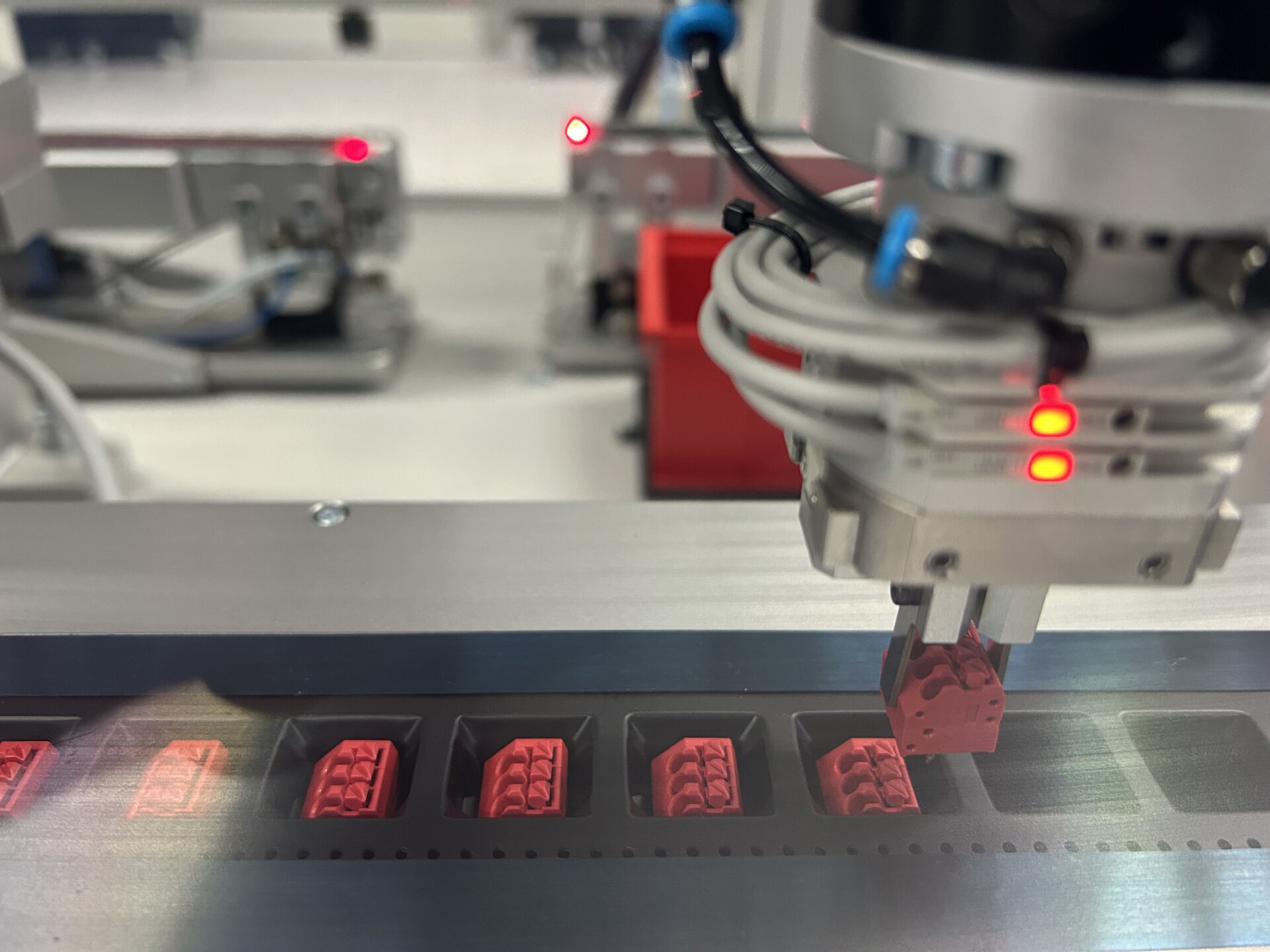
Available components are not always supplied in the tape and reel configuration required for automated processing. btv technologies uses a three dimensionally movable robotic arm to place WAGO terminal blocks precisely into blister tape. This creates a repeatable process that supports individual component geometries, orientations and lot sizes.


Not Every Project Fits a Standard Solution
There is no single packaging solution that suits every component, quantity and production process.
Component geometry, lot size, orientation, pocket design, pitch and reel format all affect whether a part can be fed reliably into the intended process.
This becomes relevant when a component is technically suitable and available, but the required tape and reel configuration is not offered as a standard packaging option. Custom component taping prepares the part for the customer’s specific feeding and production process.
Component taping describes the operation. Parts are placed into carrier tape in a defined orientation and secured with cover tape. Tape and reel describes the resulting packaging and feeding format.
For surface mount devices, this process is often referred to as SMD taping. Custom component taping is the broader term. It also covers suitable electronic and electromechanical parts such as PCB terminal blocks and battery contacts.
Automated Component Taping
btv technologies uses a three dimensionally movable robotic arm for the automated taping of electronic and electromechanical components.
The robotic arm can reach defined pick-up and placement points in three dimensions. It can therefore handle components whose geometry or original packaging requires a more flexible movement sequence than a fixed standard system can provide.
The component is picked up, moved and placed into the carrier tape in the orientation required by the intended production process. The movement sequence is configured for the component and the relevant tape and reel setup.
This creates a repeatable process for components with specific geometries, orientations and packaging requirements.
The WAGO Application
One practical application is the blister taping of WAGO terminal blocks from the WAG250 series and similar types.
The automated solution from btv technologies supports:
- 32 mm blister tape
- 13 inch reels
- 15 inch reels
- 22 inch reels
- Defined component orientation
- Automated pick and place handling
- Taping configurations based on the agreed process requirements
These technical specifications are documented in the existing btv application description.
The robotic arm picks up the terminal blocks and places them into the pockets of the blister tape in a defined orientation. The taped components can then be supplied in a format suitable for the intended automated process.
The solution supplements the manufacturer’s standard packaging options with a configuration tailored to the customer’s production requirements. The component itself remains unchanged. Only the way in which it is presented to the next production step is adapted.
Three Benefits of Automated Taping
Precise Handling
For reliable automated feeding, each component must sit correctly inside the carrier tape pocket. Its position and orientation must match the requirements of the subsequent process.
The robotic arm moves between defined pick-up and placement points. This supports repeatable positioning and reduces the risk of incorrect orientation or unnecessary mechanical stress during handling.
Automation does not replace quality control. It provides a repeatable handling process that can be combined with suitable inspection steps.
Flexible Movement
Component taping projects differ in terms of geometry, orientation, quantity and reel requirements.
The robotic arm can reach different pick-up and placement positions in three dimensions. This makes the system suitable for special component geometries and individual project requirements.
The flexible movement sequence provides additional options when manual handling becomes too time-consuming or a fixed system does not match the component.
Efficient Processing
Manual carrier tape loading becomes increasingly time-consuming as quantities grow.
Automated pick and place handling creates a consistent process and reduces manual intervention. This allows processing to scale from customised projects to higher quantities.
The solution is particularly suitable for projects that require more than manual small lot taping but do not fit a conventional standard setup.

Linking to the video streaming service is disabled to protect your privacy. Click here to activate it. By loading the video, you accept the privacy policy of the video streaming service. Further information about the privacy policy can be found here: Google - Privacy & Terms
From Terminal Block to Line Ready Material
The WAGO application shows why availability alone is not enough.
The component must meet the technical specification. Its packaging and presentation must also match the intended feeding system and subsequent production process.
Custom component taping connects two requirements:
- The standard component supplied by the manufacturer
- The requirements of the individual production line
The service does not modify the function of the terminal block. It supplies the component in the packaging and feeding configuration required by the next production step.
This means that an available component can be prepared for automated processing even when the required tape and reel configuration is not offered as a standard packaging option.
Express Processing Within 24 Hours
When the planned production date is approaching, processing time becomes just as important as the technical solution.
For suitable taping projects, btv technologies offers express processing within 24 hours.
Whether a project qualifies for express processing depends on several factors:
- Component geometry
- Required quantity
- Availability of suitable carrier tape
- Defined component orientation
- Available and approved process data
- Inspection and documentation requirements
- Availability of the components
- Completeness of the order data
A previously defined and approved configuration can be implemented more quickly than a new project for which the pocket, orientation and process parameters first need to be specified.
Express processing therefore starts with a feasibility assessment. This confirms whether the required material, project information and technical conditions are available.
The 24-hour timeframe refers to the agreed processing period. Transport and delivery times are confirmed separately for each project.
Further Applications
The same process can be used for other suitable electronic and electromechanical components.
Typical starting points include:
- Components supplied in tubes or trays
- Battery contacts and other parts supplied in bulk
- Cut tape that does not match the intended feeding system
- Special lot sizes
- Unsuitable component orientations
- Incompatible tape widths or reel formats
- Material that requires inspection or preparation before taping
Depending on the project, component taping can be combined with testing, authenticity inspection, reconditioning, drying and baking, repackaging, traceability or programming.
The required services depend on the component, its original packaging, its sourcing route and the requirements of the intended production process.
Discuss Your Taping Requirements
Do your components require a specific orientation, pocket, pitch or reel configuration?
During a personal consultation, we will review the component, the current packaging format, the requirements of your production process and the requested timeframe. For time-critical projects, we will also assess whether express processing within 24 hours is feasible.
For an initial assessment, please have the following information available where possible:
- Component number and data sheet
- Required quantity
- Current packaging format
- Requested component orientation
- Tape and reel specifications
- Required completion date
- Inspection and documentation requirements


Frequently Asked Questions About Automated Component Taping
The robotic arm can process suitable electronic and electromechanical components that can be picked up, aligned and placed safely into a carrier tape pocket.
Examples include suitable PCB terminal blocks, contacts and other parts with specific requirements for geometry or orientation.
The feasibility of a particular component is assessed using its data sheet, geometry, quantity and production requirements.
The robotic arm performs defined and repeatable movement sequences. It can pick up, align and place components precisely into the required carrier tape pockets.
Automated taping is particularly useful for higher quantities, special component geometries and projects where manual handling would be too time-consuming or a fixed standard system would be too restrictive.
Express processing within 24 hours is available for suitable taping projects.
Complete order information, suitable components, available carrier material and defined process requirements are necessary. New projects may require additional time to define the pocket, component orientation and process parameters or to complete sample inspections and approvals.
The 24-hour timeframe refers to the agreed processing period. Transport and delivery times are confirmed separately.
The following information helps us assess your project:
- Component number
- Component data sheet
- Required quantity
- Current packaging format
- Required component orientation
- Tape width, pitch and reel specifications
- Inspection and documentation requirements
- Required completion date
Any missing details can be discussed during your consultation.